
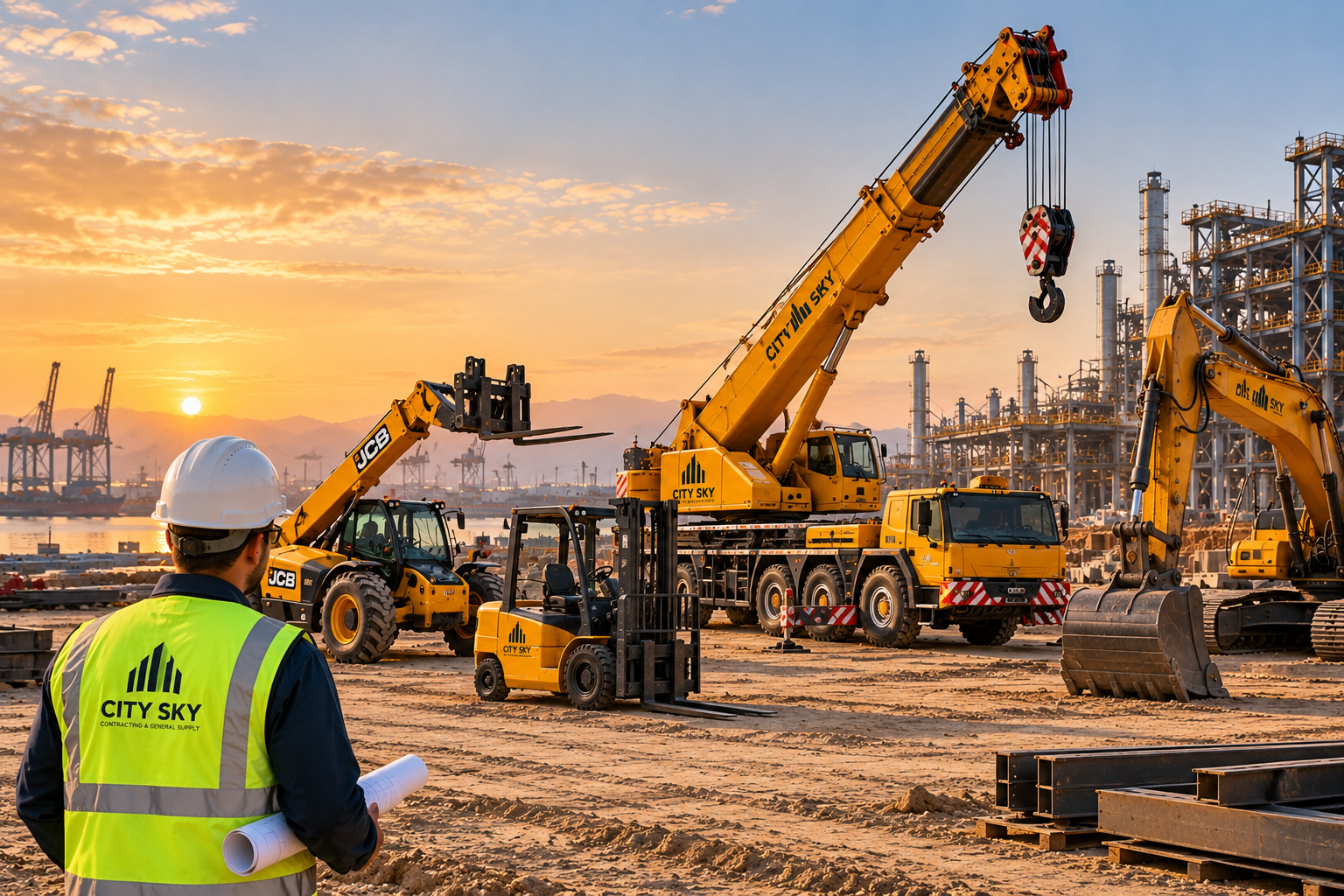
Overview
Construction and industrial projects depend on having the right equipment available when it is needed. From earthmoving and material handling to lifting operations and site preparation, machinery plays an important role in productivity, project scheduling, and operational costs.
For many contractors and industrial companies, renting equipment can be a practical alternative to purchasing and maintaining an entire fleet. It allows businesses to arrange machinery according to their project requirements without committing to the full cost of ownership.
This guide explains how heavy equipment rental works, which factors matter when selecting machinery, and how businesses can make more informed rental decisions in Egypt
1. What Is Heavy Equipment Rental?
Heavy equipment rental is the temporary use of machinery for a defined project or operational period in exchange for an agreed rental fee.
Instead of purchasing equipment, a contractor can arrange access to the machines required for a particular task. Rental periods and commercial terms vary according to the equipment, project schedule, and agreement.
Heavy equipment rental can support:
- Construction and infrastructure projects.
- Industrial facility maintenance and upgrades.
- Excavation and site preparation.
- Material handling and logistics.
- Equipment installation and lifting operations.
- Temporary project requirements and workload increases.
The main objective is to obtain suitable equipment for the work while managing cost, availability, utilization, and operational risk.
2. Common Types of Heavy Equipment
Different machines serve different purposes. Selecting equipment based on the actual work is more effective than choosing a machine simply because it is available.
Excavators
Excavators are commonly used for digging, trenching, earthmoving, and selected demolition or material-handling tasks. Selection depends on digging depth, operating weight, bucket requirements, ground conditions, and access restrictions.
Wheel loaders
Wheel loaders are used to move loose materials, load trucks, and handle aggregates or similar materials. Bucket capacity, material density, ground conditions, and travel distances influence their suitability.
Mobile cranes
Mobile cranes are used to lift and position loads at construction and industrial sites. Selection requires careful consideration of load weight, lifting radius, required height, crane configuration, and ground conditions.
Forklifts
Forklifts support pallet handling, warehouse operations, and the movement of materials around industrial facilities. Load capacity, lift height, load center, aisle width, and floor conditions are important selection factors.
Telehandlers
Telehandlers combine lifting and reach capabilities for material handling on construction and industrial sites. Buyers should evaluate maximum capacity at the required reach, working height, attachment compatibility, and ground conditions.
Important: Equipment capacity depends on the machine's specific configuration and operating conditions. Always verify the actual manufacturer's specifications before confirming a rental.
3. Equipment Rental vs. Equipment Ownership
Neither renting nor purchasing is automatically the best option. The right choice depends on how frequently the equipment will be used and the total cost of making it available.
Renting may be suitable when:
- Equipment is required for a defined project.
- Demand fluctuates throughout the year.
- A contractor needs a machine for a short period.
- Purchasing would tie up capital needed elsewhere.
- Specialized machinery is required occasionally.
Ownership may be appropriate when:
- Equipment is used consistently across many projects.
- The business can maintain and store the machine effectively.
- Long-term utilization justifies the investment.
- The company has the resources to manage servicing, repairs, and replacement.
A proper comparison should include purchase price, financing, insurance, storage, transportation, servicing, downtime, resale value, and expected utilization—not just the rental rate.
4. How to Choose the Right Equipment
Before contacting a rental provider, define the work that the machine must perform.
Start with the task. Describe whether you need to excavate, lift, transport, load, or position materials.
Determine the technical requirements. Establish the expected load, working height, digging depth, reach, capacity, and any attachment requirements.
Assess the site. Consider access roads, working space, ground bearing capacity, gradients, overhead obstructions, and proximity to other operations.
Confirm the schedule. Estimate the rental period and identify the dates when equipment must arrive and leave the site.
Check operating arrangements. Clarify whether the equipment will be supplied with an operator, whether fuel is included, and who is responsible for daily inspections and servicing.
Providing this information early helps reduce the risk of renting a machine that cannot perform the required work safely or efficiently.
5. What Affects Heavy Equipment Rental Costs?
The rental price is only one part of the total project cost.
Factors that may influence the quotation include:
- Equipment type and capacity.
- Rental duration and agreed billing terms.
- Delivery, mobilization, and collection.
- Operator requirements.
- Fuel and consumables.
- Maintenance responsibilities.
- Overtime or additional working shifts.
- Site access and operating conditions.
- Availability and scheduling requirements.
Ask for a clear quotation that explains what is included, what is excluded, how extensions are charged, and how equipment downtime is handled.
Comparing quotations on the same commercial basis is more useful than comparing headline rental rates alone.
6. Delivery, Maintenance, and Safety
Equipment planning should include more than the machine itself.
Confirm that the site can receive and position the equipment, that access arrangements are suitable, and that the machine is appropriate for the intended operating environment.
Before use, the responsible personnel should verify the equipment’s condition, required documentation, safety devices, and suitability for the task. Operators should have the appropriate competence and authorization for the equipment and site.
Maintenance responsibilities should also be agreed in advance. Establish how defects are reported, who arranges repairs, and what procedure applies if a machine becomes unavailable.
For lifting operations, additional planning may be required for load charts, rigging, ground conditions, exclusion zones, and lift supervision.
7. Questions to Ask Before Renting Equipment
Before accepting a rental quotation, ask:
- Is the proposed machine suitable for my actual work requirements?
- What are its relevant operating specifications?
- Is an operator included, if required?
- What are the delivery and collection arrangements?
- Who pays for fuel, servicing, and consumables?
- How are breakdowns and replacement equipment handled?
- What are the rental extension and cancellation terms?
- What inspections and documents are available?
- Are there any restrictions on working hours or site conditions?
Clear answers help both the customer and supplier plan the rental more effectively.
Conclusion
Heavy equipment rental can help Egyptian construction contractors and industrial businesses access machinery according to project needs while managing capital expenditure and operational requirements.
The most effective approach is to define the task, verify equipment specifications, assess site conditions, compare complete rental costs, and agree on delivery, maintenance, and safety responsibilities before work begins.
City Sky Contracting can discuss equipment rental requirements for construction and industrial projects. Contact the team with your project scope, required machinery, location, and expected rental period to begin the equipment selection process.
Find the Right Equipment for Your Project
Tell us about your project location, work requirements, equipment needs, and rental period. City Sky Contracting can discuss suitable equipment options for your operational requirements.
FAQ
Frequently asked questions
Is heavy equipment rental suitable for short-term projects?
Yes. Renting can be useful when machinery is required for a defined period, provided the rental terms and total cost suit the project.
What information should I provide when requesting a quotation?
Provide the project location, task, equipment type, required capacity or working dimensions, rental duration, expected working hours, and whether an operator is needed.
How can I avoid unnecessary rental expenses?
Select equipment based on actual requirements, coordinate delivery with the work schedule, avoid unnecessary idle time, and clarify billing and maintenance terms in advance